CPA Experts San Antonio AlternativeThe rates live on the same books.
The rates are ordinary, and they only help when the months underneath them already match the bank.
See the rates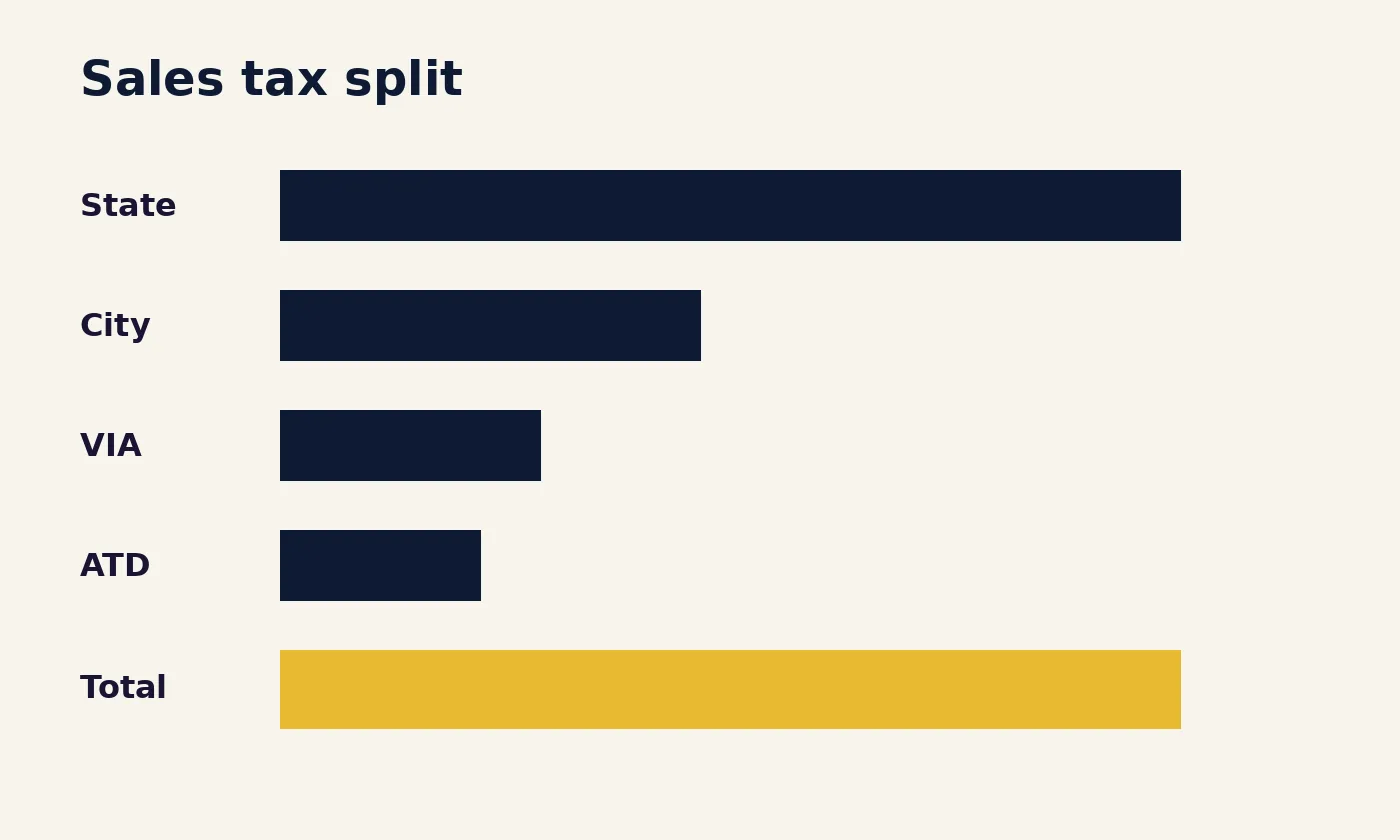
The sales tax split on the same books
Inside the city, sales tax is 8.25 percent. On the Comptroller's own split, the state keeps 6.25, the city keeps 1.125, VIA keeps half a point, and the ATD keeps 0.375. Nothing in that stack comes from a Bexar County sales tax, because the county does not levy one.
The city piece itself is 1 percent for general use and 0.125 percent for Pre-K 4 SA. A register that charges a round number someone remembers, instead of this split, is a register we want to see before the return is drafted.
Property, hotels, and the two spring filings
The city property rate is 56.288 cents per 100 dollars. Of that, 35.138 cents is operations and 21.150 cents is debt. The business property listing is an April filing, separate from the federal return.
A hotel stay can stack to 16.75 percent, made of 6 percent for the state, 9 percent for the city, and 1.75 percent for the county. If rooms are part of the month, that stack belongs in the month the stay happened.
Mid May is the franchise report for a company that owes Texas, and sending the federal return leaves that report still open. We prepare it from the closed months, and you see it before it is sent.
The tower, and what a life of a building makes us ask
The Tower of the Americas stands over HemisFair, and every Texan can place that shape. You see the tower. We see a long-lived asset and wonder, in the abstract, what a depreciated life would say, and then we come back to the building you actually own.
Your building is not the tower. The point is the habit. A rate on a page and a life on an asset both have to be tied to a source, or they do not go into the month.
Why the interview should start here
If someone cannot say the sales tax split, they are not ready to close a month that collected it. If they treat the May report as a footnote to the federal return, April will surprise you.
We keep the months so May is a filing and April is a listing, not a scramble through a year of unopened statements. The first hour can start from whichever of those dates is closest.
What we need from you for a rate to be useful
The sales tax returns you already filed, the property listing if April is near, and the newest month that matches the bank. Without that month, a rate is a fact with nothing to sit on.
Nothing on this page is a guessed rate. When the notice in your hand and the agency page disagree, we follow the agency page and we tell you that we did.
A downtown assessment, and a notice that sometimes never comes
Commercial property inside the downtown public improvement district carries an added assessment of fifteen cents per one hundred dollars of value, and a residence in that district carries nine cents. That bill is easy to treat as a rounding error until a buyer asks why the year does not match the checks. We want the assessment in the month it covers, next to the city property rate, so the year is not explaining itself in May.
The appraisal district mails a fresh notice only when a property's market value rises by a thousand dollars or more. An owner can still protest without that notice in hand. If your bill changed and the envelope never came, the month still needs the bill. We do not invent a value to fill the silence, and we do not guess a protest result. The agency figure is the one the books use, and we say so when a handed page disagrees with it.
San Antonio ISD covers downtown, midtown, and the inner city, and its calendar is the one those neighborhoods follow. A shop whose people take off when that calendar says so still has wages in the week the work happened, not in the week the form arrived. The school rate on a property bill is the district's own number. We will read it off the bill you bring. We will not print a rate here that we have not tied to your notice.
The figures on this page are for one job. They give April and May an owner before those months arrive. April holds the business property listing. The middle of May holds the franchise report for a company that owes Texas. A sales tax return keeps its own calendar on top of both. If nobody on a call can say which date is whose, the interview has not started.
Bring the returns you already filed, the property bill if you have it, and the newest month that matches the bank. A rate without that month is a fact with nothing under it. With the month, the rate becomes a line you can recognize, and the filing stops being a scramble through unopened statements.
A hotel week makes the same point with different ink. A stay can stack to 16.75 percent, six for the state, nine for the city, and 1.75 for the county. If rooms are part of the business, that stack belongs in the week the guest slept there, even when the card batch settles a few days later. We would rather see that week inside the month than discover it while a May report is already being assembled.